1

Country: South Korea | Funding: $31M
Ecube Labs develops smart waste management solutions and remote monitoring tools. Its line of products include solar-powered waste compacting bins, ultrasonic fill-level sensors that can be fitted to any type of container, and a data and predictive analytic clean city platform.
Ecube Labs develops smart waste management solutions and remote monitoring tools. Its line of products include solar-powered waste compacting bins, ultrasonic fill-level sensors that can be fitted to any type of container, and a data and predictive analytic clean city platform.
2

Country: India
SmarterHomes creats IoT water meter, WaterOn, that measures the number of units used by each apartment. It provides real-time information about the apartments' water meters, individual consumption, trends, and billing status.
SmarterHomes creats IoT water meter, WaterOn, that measures the number of units used by each apartment. It provides real-time information about the apartments' water meters, individual consumption, trends, and billing status.
3
Country: Estonia
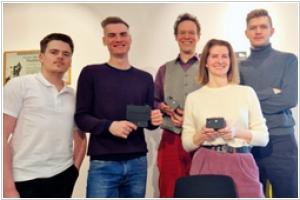
WasteLocker is an environmental firm that specializes in monitoring, reporting, and data collection services.
WasteLocker is an environmental firm that specializes in monitoring, reporting, and data collection services.
4

Country: India
KOSHA.ai produces IoT devices that verify the authenticity of textile products and ensure precise fiber identification. The device attaches directly to handlooms, records loom-specific characteristics, weaving rhythms, timestamps and short videos, which are converted into a counterfeit-proof digital trace of provenance. QR code on the finished product allows buyers to view real-time videos of the production process of their sari or fabric. The device uses near-infrared spectroscopy combined with AI-based chemometric modeling to determine fiber composition in seconds. By projecting near-infrared light onto textile sample, the system detects unique absorption and reflectance patterns, essentially creating "molecular signature" for each fiber. By integrating this device with the KOSHA tracking platform, recyclers, brands and regulators can track materials throughout their entire lifecycle, from origin to sorting, recycling and CO₂ emission reduction.
KOSHA.ai produces IoT devices that verify the authenticity of textile products and ensure precise fiber identification. The device attaches directly to handlooms, records loom-specific characteristics, weaving rhythms, timestamps and short videos, which are converted into a counterfeit-proof digital trace of provenance. QR code on the finished product allows buyers to view real-time videos of the production process of their sari or fabric. The device uses near-infrared spectroscopy combined with AI-based chemometric modeling to determine fiber composition in seconds. By projecting near-infrared light onto textile sample, the system detects unique absorption and reflectance patterns, essentially creating "molecular signature" for each fiber. By integrating this device with the KOSHA tracking platform, recyclers, brands and regulators can track materials throughout their entire lifecycle, from origin to sorting, recycling and CO₂ emission reduction.